
Seven Things You Need to Know About Recessions
Frequency, duration, sectors that hold up: seven key facts to help you understand recessions and keep a cool head when they hit.
- Rising interest rates tend to precede recessions. And that’s where we are now. What’s more, recessions are expected to be more frequent now, as central banks have less flexibility to work around them.
- They’re painful, of course, but recessions aren’t entirely a bad thing. Some of the strongest economic growth occurred when downturns happened more naturally and more frequently.
- Bonds and defensive-sector stocks with high dividend yields tend to outperform the overall market during downturns.
If you want to understand today, you have to look at yesterday – or at least that’s how the saying goes. And right now, with uncertainty and recession fears dialled up to 11, looking at yesterday seems like a good idea. That’s exactly what Deutsche Bank did recently, digging through 170 years of market history and writing a lengthy report on what the past might teach us about the present. Here are the seven most important takeaways from that report…
1. Rate hikes generally precede recessions.
When it comes to triggering a recession, no one has more firepower than central banks, and there is plenty of research to back that up. The interest rate changes they make have a massive influence on whether an economy grows or shrinks – and by how much.
When interest rates in the United States rise by 1.5 percentage points in a single year or by 2.5 percentage points over two years, there is a strong chance that a recession will occur within the next three years. And the relationship appears to be stronger in the United States than in the United Kingdom, Germany or France. This heat map shows which variables occur most consistently before a recession. The redder the grid, the hotter the relationship. With US interest rates having risen by more than 5 percentage points in less than two years, statistically speaking, you shouldn’t be too surprised if a recession follows.
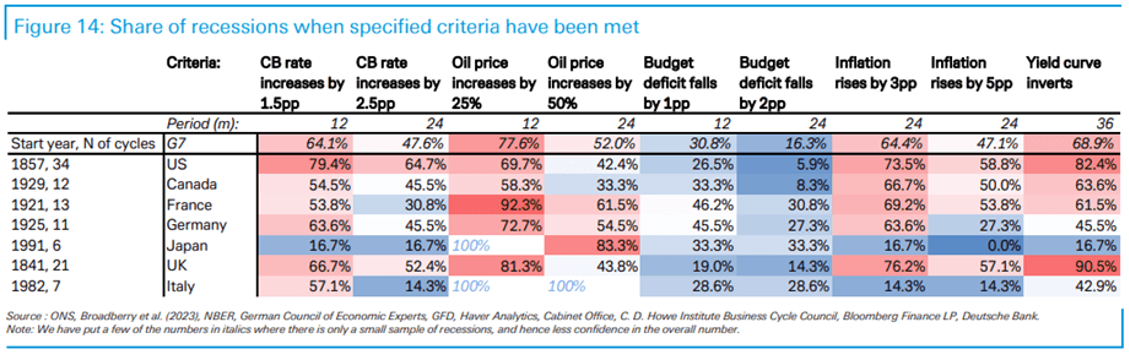
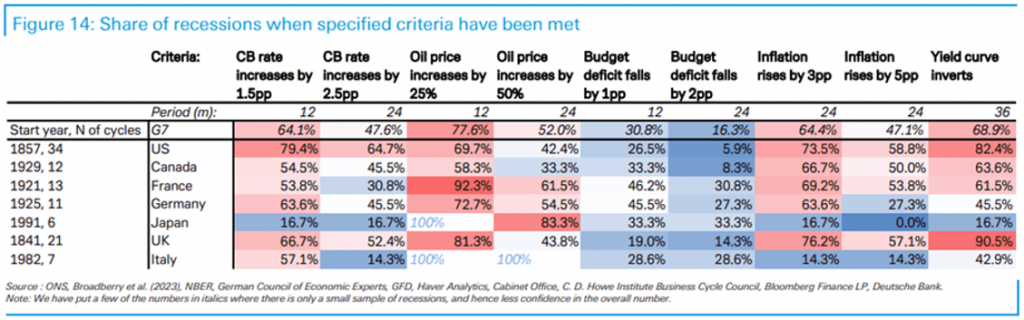
Share of recessions when specific criteria have been met. Sources: ONS, Broadberry et al. (2023), NBER, German Council of Economic Experts, GFD, Haver Analytics, Cabinet Office, C.D. Howe Institute Business Cycle Council, Bloomberg Finance LP, Deutsche Bank.
2. Recessions used to be much more frequent.
Now, in the old days, before the Second World War, long economic booms were quite rare around the world. Back then, economies relied mainly on agriculture, which made them more vulnerable to bad weather and tended to lead to ups and downs in output. But even as economies became more industrialized, economic policy wasn’t always geared toward prolonging the good times. Money was often tied to gold, and the prevailing wisdom was to balance budgets.
Before 1982, the average economic expansion lasted only 2.8 years and, overall, 35% of the time was spent in recession. Since 1982, however, it’s been a different story: the average time the United States has spent in a good economic groove (expansion) has been about 8.6 years, and only 8% of the time has been spent mired in recession. So you could say that recessions have become much less frequent. Over the past 40 years, the United States, Germany and France have each experienced only four recessions, while the United Kingdom and Canada have experienced only three.
3. Recessions generally haven’t lasted very long.
The good news is that recessions generally don’t tend to last. Capital Group’s analysis of 11 business cycles since 1950 shows that recessions have generally lasted from two months to 18 months, with the average spanning about 10 months.
But there’s a twist: before 1982, even though roughly one-third of the time was spent in recession, the economy still posted solid growth of 3.7%. Over the past four decades, developed countries have failed to keep up that pace, despite longer periods of growth.
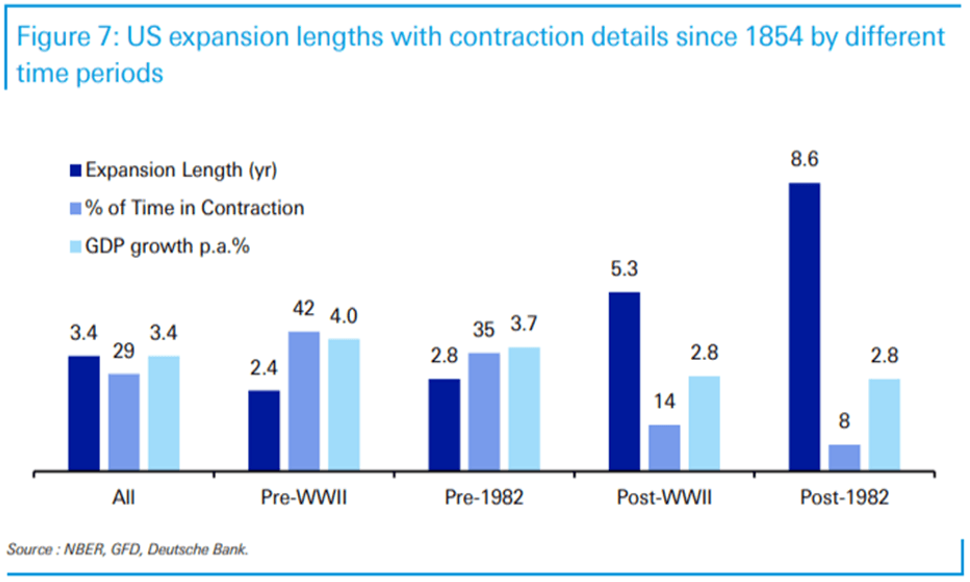
The average length of US economic expansions, the percentage of time spent in contraction and average annual economic growth, over different periods, going back to 1854. Sources: NBER, GFD, Deutsche Bank.
4. Recessions aren’t necessarily a bad thing.
Recessions happen for a variety of reasons, usually because the economy is a bit out of balance and needs a reality check. They’re hard to get through, but they’re a necessary kind of “cleansing” that takes place before the next economic boom. Some of the best economic growth has occurred alongside more natural, more frequent recessions.
Take the United States, for example: it has had more ups and downs than its buddies in the Group of Seven club of major advanced economies over the past century. But it has also had some of the strongest economic growth. And that’s because recessions can actually help clear out the excesses and bubbles of previous cycles, making room for exciting new industries to thrive. Without recessions, the risk is that inefficient sectors persist, dragging the whole system down.
Looking to invest during a recession? Let one of our advisors guide you.
5. Central banks now have less room to manoeuvre in managing recessions.
Although recessions aren’t all bad, most governments view them as major disasters to be avoided at all costs. This has led to some fairly aggressive action from policymakers who want to do everything they can to make recessions as short and painless as possible.
But there’s a point where it gets tricky. You see, most countries have racked up a ton of debt, both government and household. That means no one has much room to manoeuvre to deal with future economic bumps. And, with interest rates on the rise, making borrowing more expensive, and with inflation still climbing, this could lead to wild swings in interest rates and the economy in the years ahead.
The real test will come with the next recession. Without additional levers to pull, such as cutting interest rates and holding them at extremely low levels with the kind of massive bond-buying programs central banks have used since the global financial crisis, there is no guarantee that an economy can manage future recessions as skilfully as it has since the 1980s.
6. Recessions are expected to become more frequent again.
With central banks lacking some of the tools needed to avoid recessions, it’s probably no surprise that we’ll be seeing more of them. Historically, government deficits have played an important role in helping to smooth out economic cycles. But with countries’ debts at historically high levels, the idea of issuing new bonds to support and smooth out economic cycles will be a harder pill to swallow. It’s no coincidence, after all, that the recent decades-long era of stable, low inflation occurred alongside longer economic growth cycles. If high inflation persists, central banks will face a dilemma: should they prioritize meeting their 2% inflation targets, even at the expense of economic growth and maximum employment?
7. Sectors with high dividend yields, and bonds, perform best during recessions.
Investing isn’t easy during a recession. In fact, bear markets often overlap with them. But here’s an interesting fact: stocks generally start to slide about six to seven months before the economy dips, and they’re often back on their feet before things clear up.
The chart below shows which sectors tend to perform well during recessions. In general, you’ll find that defensive, high-dividend-yield sectors – like consumer staples and utilities – tend to outperform the overall market. Some of the best returns come when the economy is booming after a market plunge. So, rather than sitting out the recession, it would be wise to stay invested and consider dollar-cost averaging. The strategy, which involves investing a fixed amount at regular intervals regardless of market conditions, can help you get more of the shares you want at optimal prices. And it ensures that, when the market bounces back, you’re in an ideal position to capture gains.

Over the past ten economic downturns, some sectors have finished above the overall market. Source: Capital Group, FactSet.
And when things get tough in the economy, bonds can be your secret weapon too. They bring a degree of stability and can help preserve your money, especially when stocks are all over the place.
Of course, in 2022, things were a bit unusual: bonds didn’t play their usual safe-haven role during the market chaos. But over the past seven market hiccups, bonds, as measured by the Bloomberg US Aggregate Index, rose four times and never fell by more than 1%.
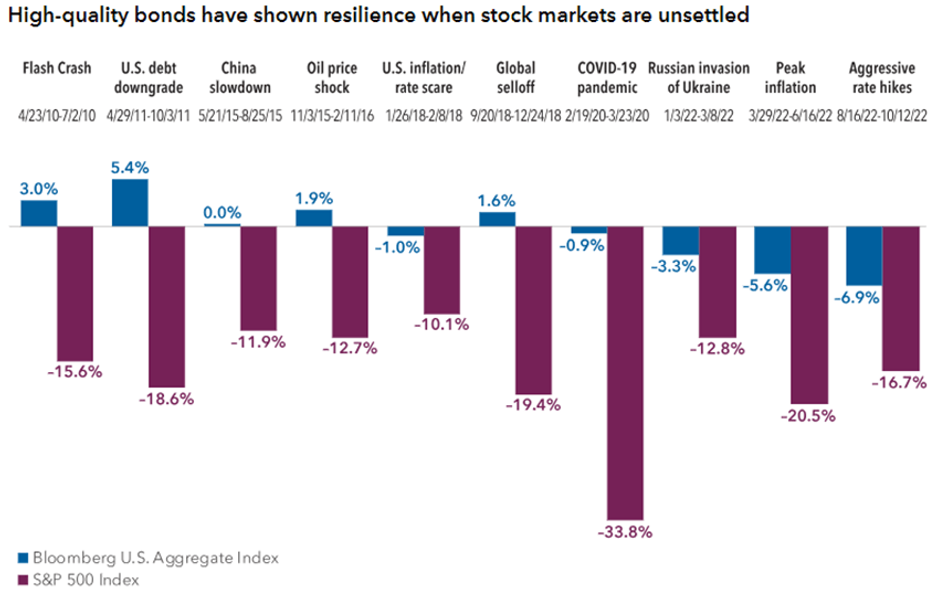
High-quality bonds have generally shown resilience when stock markets have been unsettled. Sources: Bloomberg Index Services Ltd., RIMES, Standard & Poor’s.
Curious how this applies to you? Try our free calculators — monthly cost of living, retirement projection — or book a conversation. One article a month by email? Join the newsletter.