

Geopolitical Instability and Its Impact on Markets
War in Ukraine, inflation, energy tensions: how geopolitical instability is shaking markets — and the reference points to hold on to.
Using the past to understand
the present and the future
Withdrawing from agreements with Russia leads to the thinking that this could create long-term opportunities in thematic investments, especially on the side of renewable energy and local food production.
One easy hypothesis to observe is that stock market indices tend to be negative during periods of geopolitical crisis. Legendary Wall Street investor Barton Biggs, who worked for Morgan Stanley in 1975, wrote a book (Wealth, War and Wisdom) on how the Second World War affected stock markets. The investor mentions that when it comes to the market, “the news doesn’t need to be good, it only needs to be less bad than what analysts had anticipated.”
Today, investors have a surplus of information in the news and on the internet. It is far too easy to fall into the trap of panic and make rash moves driven by fear. In effect, doing the opposite of what the renowned Vice Chairman of Berkshire Hathaway, Charlie Munger, suggests: “It can be very rewarding to be patient.”
Getting to know the historical returns of different asset classes in times of conflict can help investors avoid the trap of panic.
The years follow one another, but no two are alike
During the First World War, United Kingdom government bonds went from 9% to 33% in annual return.
In Canada, on March 6, 2020, 10-year Government of Canada bonds stood at 0.52%; on November 23, 2022, the rate was 3.2%. An increase of 515%, which brings attractive bond return opportunities for the months/years to come.
What this shows us: conservative/balanced investments, which were mediocre in 2020-2021-2022 due to low interest rates, should in some way have a good year in 2023.
Patience pays off
In 1914, when Europeans were selling all their American positions, the New York Stock Exchange decided to close the stock market. On December 12, 1914, the Dow Jones (DJIA) ended the day at -24%, the worst day since its launch in 1986. In 1915, the DJIA stock index ended the year with a positive return of 81.5%.
Five major events from the past
- September 2, 1945: at the end of the Second World War, the S&P 500 posted a positive return of 30.7%.
- November 22, 1963: following the assassination of John F. Kennedy, the S&P 500 fell 2.8%; the market recovered after 1 day.
- August 2, 1990: Following the invasion of Kuwait, the market dropped 1.1% and took 71 days to recover.
- September 11, 2001: on the day of the attacks, the S&P 500 suffered a 4.9% decline; the recovery was quick.
- February 24, 2022: the S&P 500 fell to its lowest level in 9 months after Russia’s attack on Ukraine.

What the research has shown
Research conducted by Mark Armbruster, who studied the years 1926 to 2013, showed that small-capitalization stocks were an asset class that had performed very well. “Our research revealed that although there is an initial knee-jerk reaction following a conflict, it fades as markets begin to digest the reality of a conflict. Economic fundamentals then begin to take over again.”
The difference in 2022-23
The current situation is different from recent conflicts; rising interest rates, inflation and a recession on the horizon mean that many stocks are/were overvalued. This environment means that investors will have a hard time seeing results similar to those of recent years.
Cryptocurrencies as speculation,
but not as protection
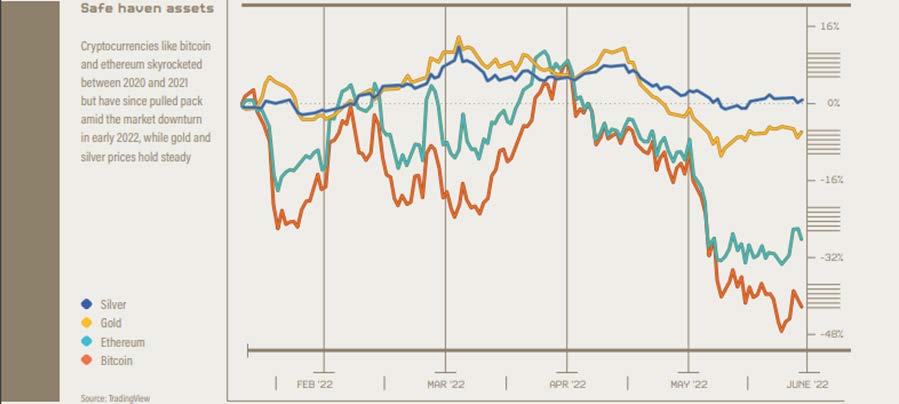
During the “wild” years of 2020 and 2021, Bitcoin and Ethereum had strong moments. However, in 2022, both cryptocurrencies showed that they are not a tool for protection against the markets. Gold and silver, for their part, proved that they are.
Conflicts, a catalyst for change
It took the Second World War for people in the United States to have access to free care for the first time. Before the conflict, getting medical care was a challenge and hospitals were run by charities and churches.
The war in Ukraine shows that the world depends on Russia for its gas supply. 41% of the European Union depends on Russia for its gas supply, which is currently causing a problem. The situation quickly created a need on the side of alternative renewable energy. This will have accelerated the shift toward clean energy and the reduction of
carbon emissions.
In the short term, the returns of oil-related listed companies are performing well due to the lack of resources; in the medium to long term, the appetite for and returns of alternative energy stocks will no doubt see fine success.
What remains of interest?
With the points listed in this text on macroeconomics, investment opportunities on both the equity side and the bond side are enticing. All that remains is to determine which investment style the focus should be placed on.
In 2020 and 2021, growth-style stocks enjoyed enormous success. IPOs came one after another, technology stocks were being bought at crazy prices, and in 2022 those same stocks suffered an enormous shock.
The shift is now toward what are called “value”-style stocks — quality stocks with excellent balance sheets. These are the best investments to hold during turbulent economic situations. The rotation between the growth style and the value style was caused by inflation and rising interest rates. The mix between these two styles of stocks is called: growth at a reasonable price.
Fidelity manager Daniel Dupont, in 2016: “I want to invest in a company when the impact of macroeconomic factors is disproportionate relative to the valuation of its securities.” He means that sometimes market noise (the news, etc.) will drive a stock’s price down far more than the stock’s real value. That company then becomes a potential target for this type of manager.
One thing is certain: investing without a plan is like driving without a GPS. With a plan in place and well-defined objectives, the latest crisis of the day should not affect an investment plan.
Recommendations
Quality small caps
- Fidelity Small Cap America
- Fidelity Global Potential
- Fidelity Global Small Cap
- Mackenzie Canadian Small Cap
- Mackenzie US Small-Mid Cap Growth
- Canoe Canadian Small Mid Cap Portfolio
- Mackenzie Greenchip Global Environmental All Cap
Quality / value-style equities
- BMO Low Volatility US Equity ETF
- Fidelity Global Intrinsic Value
- Fidelity Canadian Large Cap
- Fidelity Global Equity – Concentrated
- Fidelity American Equity
- Canoe Defensive US Equity Portfolio
- Fidelity Global Value Long/Short
Bonds (more attractive since rates increased)
- Canoe Bond Advantage Portfolio
- Fidelity Multi-Sector Bond
- Fidelity Global Core Plus Bond ETF
- Fidelity Canadian Short Term Corporate Bond ETF
Alternative investments
- Secure Capital MIC
- MVMT Capital
- Trinity Hotels
- Invico
- NewOak Finance Equity Fund
- Watt by Watt Equity Fund
- BWS Capital Equity Fund
Sources:
- Investing in times of crisis: What can historical market performance reveal about investing during times of conflict?
- Equity funds: value approach or growth approach?
Curious how this applies to you? Try our free calculators — monthly cost of living, retirement projection — or book a conversation. One article a month by email? Join the newsletter.