
Giving Your Children a Financial Head Start
The most powerful factor in saving is not income — it is time. Four concrete ways to pass on financial discipline early and give your children decades of head start.
In our meetings, many of you share the same concern: how do we financially prepare the next generation in a context where home ownership and retirement both seem more demanding than they used to be?
The good news is that the most powerful factor in saving is not income — it is time. A dollar invested at age 10 has decades to grow before your child ever needs to touch it. Here are four concrete ways to pass on that discipline early.
1. Make saving visible and tangible
A children’s bank account, even one funded with small regular amounts, lets a child watch the balance grow. The “divide in three” rule — save, spend, share — teaches from a young age that part of any money coming in has a specific destination before it is ever spent.
2. Value portfolio growth as much as bricks and mortar
We have long equated financial success with owning a home. That value is legitimate, but it is no longer the only path to financial security. A striking example: in Switzerland, one of the wealthiest countries in the world, the home-ownership rate hovers around 40% — well below the European average of nearly 70%. Yet Switzerland has a very high proportion of millionaires, with wealth built largely in financial markets rather than residential real estate. The pride of watching an investment portfolio grow deserves to be celebrated just as much as the pride of owning a home.
3. Involve your child in real financial choices
A simple budget for a specific project — a toy, a bicycle, a school trip — teaches patience and trade-offs better than any lecture. Later on, a first FHSA or RRSP, however modest, opened upon entering the workforce, benefits from an exceptional growth horizon.
4. Take the drama out of today’s context
Yes, property prices have climbed, and qualifying for a mortgage on a single income is harder than it once was. But that reality should not discourage saving — it should encourage starting earlier and diversifying goals, whether that means one day buying a home, building a solid retirement cushion, or simply having the freedom to choose.
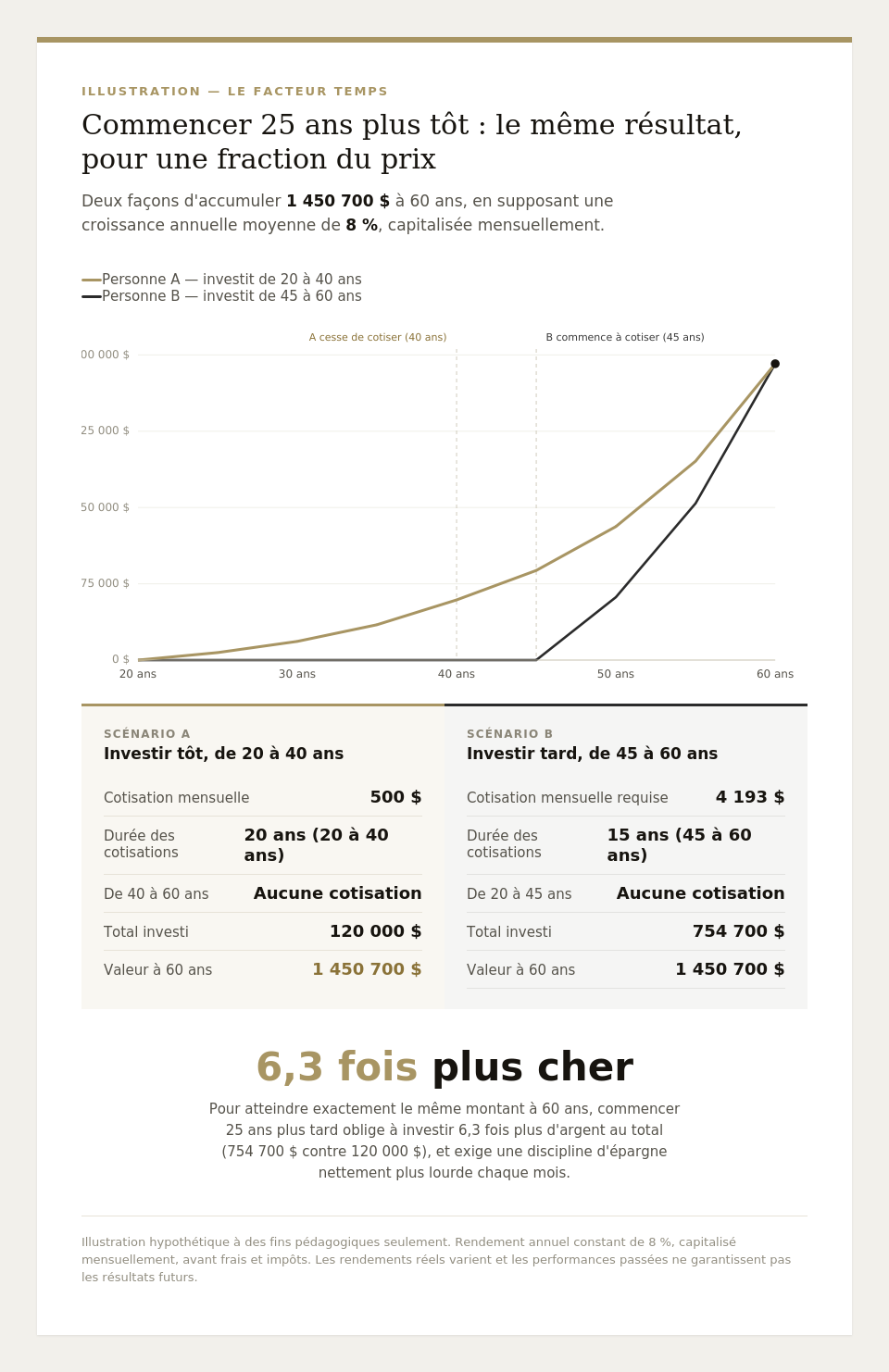
The earlier you start, the lighter the task.
Let’s talk about it
If you would like to discuss strategies for your children or grandchildren — whether a registered education savings plan, a first investment account, or a broader conversation about passing on sound financial habits — we would be delighted to talk with you. Book a conversation with our team.
Curious how this applies to you? Try our free calculators — monthly cost of living, retirement projection — or book a conversation. One article a month by email? Join the newsletter.