

A look back at 2025
Our analysis of the major trends that shaped 2025 and what they mean for your portfolio in 2026.
The unknown
The start of each year means hope and promise—a blank page for a fresh start.
Last year belongs to the past, and the future, that great unknown, awaits us.
This prospect can be both thrilling and frightening, because no one knows whether the future will be cruel, peaceful or chaotic.
And very often, it will be all of these at once—and 2025 was no exception.
The tariff crisis
When the S&P 500 erased all of its year-to-date gains in March, most investors saw it as nothing more than a temporary pullback.
Yet a storm was quietly building. And by early April, it had turned into a full-blown hurricane.
Finding a specific “cause” for a sharp market drop is often difficult. But this time there was no ambiguity: the markets were mainly worried about trade wars and tariff increases.
On April 2, “Liberation Day” arrived, along with “reciprocal tariffs” far higher than expected across nearly every country in the world.
The market’s reaction was very swift: by April 7, the S&P 500 had fallen 21%, making it the second-fastest descent into a bear market in history.
When the market closed on April 8, it had already lost more than 15% year-to-date, making it the fourth-worst start to a year in history.
Reversal
When were the new punitive tariffs supposed to take effect?
April 9.
And when did they actually begin?
Never.
On April 9, President Trump completely changed course and announced a 90-day pause on the planned tariff increases for every country… except China.
That day, the U.S. stock market surged 9.5%, its third-largest single-day gain since 1950.
In the weeks and months that followed, the same script played out over and over. New tariffs were announced or threatened… then withdrawn or postponed hours or days later. And each time the government backed down, the market rebounded sharply, erasing not only the previous losses but also adding new gains.
That is how the strategy nicknamed the “TACO trade” was born, for “Trump Always Chickens Out” — in other words: Trump always ends up backing down after announcing aggressive tariffs. And with each new tariff threat, the market declines grew smaller, because fewer and fewer investors believed the measures would actually be enforced.
By the end of June, tariff-related fears had completely faded, and the S&P 500 had returned to its all-time highs.
It was one of the fastest market turnarounds in history: the S&P 500 gained 22% in just 12 weeks.
It took less than three months after the April 2025 bear-market low for the S&P 500 to reach a new all-time high. It was the second-fastest recovery in U.S. equities in 75 years, just behind the spectacular rebound of 1982.
During bear markets, it often feels like you can step out of the market and come back later, “when things get better.” The problem is that by the time things finally feel reassuring, the best days and the biggest gains have already passed. That is exactly what we saw once again in 2025.
The world strikes back
If someone had told you the United States would raise its average tariffs from 2% to 14% in 2025, you would probably have thought it would hurt international stocks—since U.S. imports would fall and the dollar would strengthen.
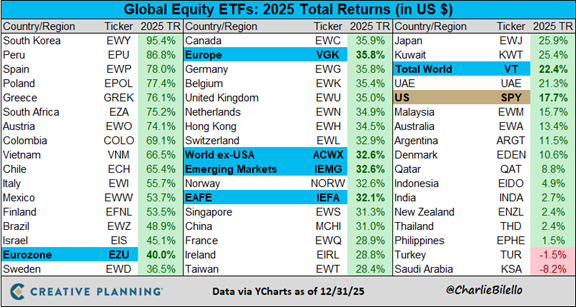
But in reality, exactly the opposite happened. Imports rose sharply, as companies rushed their purchases ahead of the tariffs taking effect. And international stocks outperformed U.S. stocks by the widest margin since 1993.
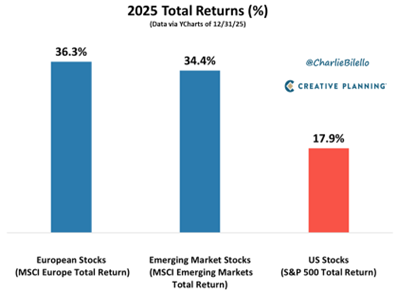
“Why should I own anything other than the S&P 500?”
That was the question investors were asking at the start of 2025.
Now they have their answer…
The triumph of the optimists
The recession many were forecasting during the April tariff panic… never came.
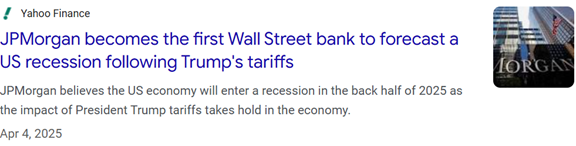
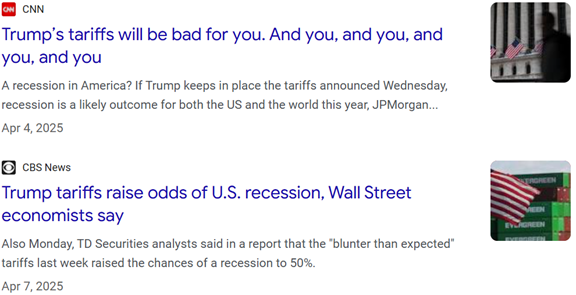
This now brings the U.S. economic expansion to 65 months—and counting. Most analysts now expect it to continue for at least one more quarter (the Atlanta Fed’s latest Q4 GDP estimate: +2.7%).
The S&P 500 ended the year with a total return of 18%, posting a double-digit gain for a third consecutive year.
What drove the U.S. stock market higher?
Earnings… and expectations.
S&P 500 operating earnings rose 13% during the year, reaching new all-time highs.
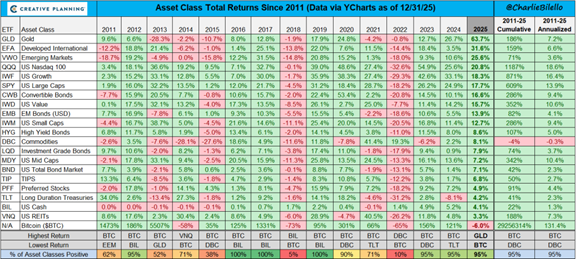
With the exception of Bitcoin, every major asset class ended 2025 in positive territory, led by gold, which jumped 64%.
What now?
These charts and themes told the story of 2025. As always, the narratives follow price movements.
And when prices change in 2026, the narratives will change too.
Where will the S&P 500 end 2026?
What will the 10-year bond yield be?
Where is the price of crude oil heading?
Is gold or Bitcoin the better investment today?
How many times will the Bank of Canada and the Fed cut rates in 2026?
Will inflation finally fall toward the Fed’s 2% target?
When will the economy enter a recession?
I have the answer to none of these questions.
As Lao Tzu said: “Those who know do not predict. Those who predict do not know.”
What is the alternative?
Analyze the facts as they come, invest according to probabilities, stay humble and grateful, and leave the predictions to those whose job is to entertain. In this unpredictable field that is investing, the best you can do is find a strategy suited to you… and stick with it long enough to fully enjoy the magic of compound returns.
For 2026, I predict only one thing: there will still be plenty of surprises. That is the very nature of the markets.